Category Archives: Side Dishes (Banchan)

Instant Dumplings (Mandu in Korean)

Instant dumplings- Panfried mandu

One thing I don’t like about winter is its weather. It is just too cold, so I am not as motivated as other seasons to cook any meals. I just want to stay in my room and snuggle up. However the fact that we have to eat to survive is what makes me still cook something. I have to admit that I am a lazy cook. :D

So this is what we had for dinner last night. No rice! No Kimchi! Just some instant fried mandu. (We had kind of a big lunch luckily, so we could cope with just some mandu for dinner.)

instant dumplings

I bought these packs last week at Homeplus. It was really a good deal, because I got these two packs (total 2.4 kg) for 5,880 won (US $ 6.20). Great Bargain isn’t it? So I still have lots more bunches to go. (I am planning to make some mandu soup this weekend.)

I pan fried them, not deep frying. I think pan frying is a more common way to eat mandu instead of deep frying in Korea, and pan fried mandu is called “Gunmandu” in Korean. To get the best result (crispy texture), defrost them completely before you cook them.

You can also steam them or cook them with a microwave.
If you steam them, you can get a result like this. (Eat them when it is still hot. When it gets cold, it is not yummy.)

Instant dumplings- Steamed mandu

Steamed mandu is “Jjinmandu” in Korean and I personally prefer fried mandu.

There are lots of kinds of mandu, such as Kimchi mandu, Meat mandu, Squid mandu, Seafood mandu, even Pizza mandu. The mandu I bought was Japchae mandu.

You can use some soy sauce as a dipping sauce, but I added some extra ingredients for flavour.

Sweet and sour dipping sauce : (Mix these in a bowl)

  • Soy sauce – 2tsp
  • Vinegar (I used apple vinegar) – 1/2 tsp
  • Plum extract – 2 tsp
  • Garlic – 1/10 tsp
  • Chili powder – 1 sprinkle
  • Sesame oil – 1 dash

Related Posts

My Failed Kimchi Dumplings (Kimchi Mandu in Korean) and What I have learnt

Dumpling Pastry Pizza (Mandupy Pizza in Korean)

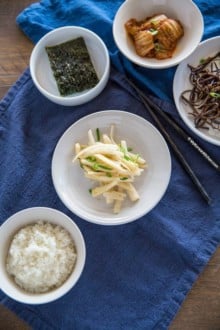
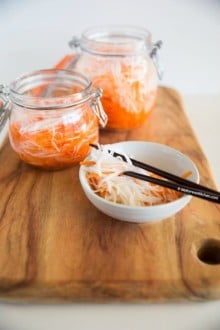
Thinly Sliced Radish Kimchi (Mu saengchae in Korean)

Thinly Sliced Radish Kimchi on the magazine

As I announced yesterday, today’s recipe is thinly sliced radish Kimchi, which is what I enjoyed with bossam on the weekend. It is very cheap to make (I spend 500 won – US $0.50 on a big size radish) and very easy to make, though it can hurt your hands or back, if you are not good at thin slicing.

Ingredients

Thinly Sliced Radish Kimchi radish
  • 1/2 a big white radish (daikon) – I was going to use up a whole radish, but it was just too much slicing work for me. So I decided to use only half of it.

For Sauce

  • Salt – 1tsp
  • Anchovy sauce- 1 tbsp
  • Chili powder – 1 tbsp and 1tsp
  • Minced garlic – 1 tbsp
  • Sugar – 1 tbsp (I used dark brown sugar)

Step 1. Peel the radish with a peeler, then thin slice the radish. (if you have a slicer, use it, it is hard work to thin slice it.)Thinly Sliced Radish Kimchi making

Step 2. Put the sliced radish into a big bowl, add all the sauce I mentioned.

Step 3. Mix them well with your hands. (I recommend you wear a glove when you mix it, otherwise the sauce can sting your skin.)

Step 4. Serve it on a plate. (You can eat it straight away or wait until the next day. I found overnight fermented Kimchi tastes better.)

I really loved how it turned out. It wasn’t heavily seasoned Kimchi, so I could enjoy the simple fresh taste.

Related Posts

Steamed Pork Wrapped in Leaves (Bossam in Korean)

Radish and Oysters on Rice (Gulbap in Korean)

Soy sauce Boiled Tofu (Dubu Ganjang Jorim in Korean)

soy sauce boiled tofu on the magazine

I don’t like tofu (Dubu in Korean) on its own, but I really like it when it is cooked with something else, like Tofu Soybean Paste Stew (Dubu Doenjangjjigae in Korean) or this meal, soy sauce boiled tofu. Tofu is a really cheap, healthy meal, and is suitable in lots of food. This side dish is especially really easy to make.

Ingredients for 2-3 person side dish

(Expected prep time: 2 minutes , cooking time: 4 minutes )

soy sauce boiled tofu ingredients

  • Tofu 280 g
  • 1/2 stalk of a spring onion
  • Olive oil 15 ml

For sauce (mix these in a bowl)

  • Soy sauce (Ganjang in Korean) – 3 tsp
  • Sugar – 1 tsp (I used dark brown sugar)
  • Garlic – 1/4 tsp
  • Sesame oil – 1/4 tsp
  • 1 green chili

Prep

  1. Cut the tofu into pieces.
  2. Take the seeds out from the chili and thin slice it.
  3. Thin slice the spring onion.

Cooking

1. Put some oil into the pan.
2. Add the tofu. Pan fry it both sides.

soy sauce boiled tofu panfrying tofu

3. Turn the heat down to low heat, add the sauce and spring onion, then simmer it. (turn the tofu over half way)

soy sauce boiled tofu simmering tofu

4. When 80% of the sauce disappears, serve it on the plate, then pour out the rest of the sauce on the tofu.

Although it contains chili, the actual dish isn’t spicy.

Recipes that contain tofu

Pork and Kimchi Stew (Dwaejigogi Kimchijjigae in Korean)

Tofu Soybean Paste Stew (Dubu Doenjangjjigae in Korean)

Uncurdled Tofu Stew (Sundubu Jjigae in Korean)

My Failed Kimchi Dumplings (Kimchi Mandu in Korean) and What I have learnt

Failed Kimchi mandu on the magazine

Yesterday, I was reading a post from one of the prominent food blogs, the Traveler’s Lunch box. While I was reading it, it reminded me “again”, how hard it is to have a food blog, especially a recipe blog. Some hard things about having a food blog are (this is what he said) time, literary inspiration, and failed recipes, which all apply to me.

Cooking is indeed a time consuming job. This Kimchi mandu took me about 3 hours until I bit a piece. It was my first trial I remind you, still 3 hours is just too much. Don’t you think? The most stupid thing I did was that I had planned to make this meal on Monday, which is very hard for my and Michael’s body to cope because we weren’t ready to do such hard work at the beginning of the week. I was going to do all the work by myself, which would have killed me, though after making 2 mandu I asked him to help me.

The worst part of all was that the mandu wasn’t presentable for shooting. It tastes nice, but not the best, because the pastry was too thick (rolling the dough was Michael’s job by the way). Come on Mandu, we spent our whole dinner time (5:30 to 8:30) to make you, on “Monday”. I was so frustrated. I could only save 3 pieces of mandu out of 30 steamed ones. I had such great plans for this Kimchi mandu before I started. I was going to steam some, fry some, and make some mandu soup.

I wasn’t going to post any of the article related to the Kimchi mandu until I succeed, but it taught me some good lessons about how to make delicious mandu, efficiently. So I would like to share these with you as I know some people are very keen on cooking this dish right now. Here is the recipe and detailed ideas how it should work. (By the way, I added some pictures to show how I failed, so don’t follow the pictures exactly.) :)

Kimchi Mandu Ingredients

For mandu pastry (It will give you 30 pastries)

  • White flour 3 cups
  • Water 1 cup

For mandu filling (You can make about 45 mandu with this filling)

- How would I know this? When I was short of hand made pastries, I used left over pastries from my dumpling pizza recipe.

  • Kimchi 400 g
  • 1/2 an onion
  • Green bean sprouts 150 g
  • Tofu 140 g
  • Minced pork 200 g
  • 1 egg
  • Minced garlic – 1/2 tsp
  • Salt – 1 tsp
  • Sesame oil – 1tsp
  • Pepper – 3 sprinkles

Preparation

  1. Sieve the flour, add the water, then knead. (The more you knead it, the yummier it gets)
  2. Finely chop the Kimchi, onion, tofu, and pork.
  3. Par boil the green bean sprouts and chop them finely too.
  4. Squeeze the Kimchi, onion, sprouts, tofu, and meat separately. (It is the one of the hardest part. If you have a straining cloth, definitely use it. I didn’t have one so it was harder to squeeze with bare hands.)
  5. Mix them in a big bowl (salad bowl), add the garlic, salt, sesame oil, pepper, and egg.

Failed kimchi mandu step1

Steps

  1. Knead the dough, cut it into pieces.
  2. Roll the cut pieces. (into round shapes)
  3. Put the rolled pastry on one hand and add filling on top. (I used a mandu shaper, but you can just do it with your hands.)
  4. Seal the pastry then place it on a plate or clean table.
  5. Repeat 1 to 4 until you use up all the ingredients.
  6. Steam it.

Failed kimchi mandu step 2

How to make “successful” mandu

  • Make mandu when you have a full day or at least a half day free to spare. (As I said it is a time consuming job, also there is a mess to clean up afterwards too)
  • You will need a big open space. Some Koreans spread old news papers on the floor, and make mandu on the floor. It is easy to spread things, also easy to clean up later. (Flour will be everywhere.)
  • When you make the dough, using warm water is better apparently. Also leave the dough at room temperature for about 1 hour, before you use it.
  • Make an assembly line, and share the job. (You will need at least 3 people, one person to knead the dough, cut the dough, collect fragmented dough and hand out the cut dough to the rolling person, another person to roll the dough, and another person to make the mandu.) I bet kids will love to participate with the kneading.
  • Before you start rolling the dough, spread flour on the board and the dish where you put the mandu. (Otherwise it is hard to separate the dough or mandu later.)
  • When you roll the dough, make it thin but not to thin. (I know how you would feel about this. If it is thick, mandu wouldn’t taste nice, and if it is too thin, it will tear out.)
  • You don’t need any fancy mandu shaper to wrap the filling. I bought a mandu shaper to make it easier, though once you steam it, it doesn’t look as good as hand made mandu.
  • When you steam some mandu, lay the white cloth (straining cloth) underneath it, it is easier to take mandu out from a steamer that way. Otherwise it will loose its good shape.

This is a picture of mandu I sealed with my hands. (You can seal it into whatever shape you want, I fold it in half then wrap the ends round to touch each other)

failed handmade kimchi mandu

How to enjoy “delicious” Mandu

  • Eat it when it is still warm. It doesn’t taste as good when it gets cold.
  • Serve it with some sauce (Mix of soy sauce – 1 tbsp, sugar – 1/2 tsp, chili powder 1/4 tsp, a dash of vinegar and sesame oil) and yellow pickled radish (Danmuji in Korean)
  • You can enjoy mandu in different ways. You can steam it or fry it, also make some soup with it.

This is a picture of three mandu I saved. :)

Failed steamed kimchi mandu

How to keep the left over Mandu

I have some mandu left over. I intentionally left some to make some soup, which didn’t turn out well either, because I didn’t store them properly.

  • Steam all the left over mandu, and cool them down completely. Then put them into a plastic bag, keep it in the freezer. (When you use them again, defrost it for 1 hour on room temperature.)

If you follow my “How To” series well, you won’t fail. ;) By the way, I will try another one in 2-3 weeks.

Related Post

Steamed Kimchi Dumplings (Jjin Kimchi Mandu)

Dumpling Pastry Pizza (Mandupy Pizza in Korean)

Instant Dumplings (Mandu in Korean)

Rice Cake and Instant Dumpling Soup (Ddeok Mandu Guk in Korean)

Oyster pancakes (Gul Jeon in Korean)

Oyster pancakes on the magazine

Apparently, oysters taste best and have the most nutrition in the winter season (From November to early March) in Korea. I bought 2 packs of oysters (total 400 g) for the price of one the other day and we enjoyed it a lot. They are usually about 2500 won (US $2.60) for 200g pack. Oysters are often referred to as “the milk of the sea“, because they contain lots of calcium. They are also very popular as a stamina food for Korean guys. ;)

Ingredients
(Expected preparation time – 23 minutes, Expected cooking time – less than 10 minutes)

Ingredients for oyster pancakes

  • 1 egg and 1 egg yolk (to make the pancakes yellower)
  • Refined rice wine 1/4 tsp
  • Pepper – 1 sprinkle
  • Salt – 1 sprinkle
  • White flour – 2 tbsp
  • 1 red chili
  • 4 stalks of garlic chives
  • Oyster 150g

PreparationOyster preparation

  1. Soak the oysters in cold water for about 15 minutes. (add some salt)
  2. Drain the oysters and dry them in the air.
  3. Put the flour into the plastic bag and add the oysters. Shake it.
  4. Finely chop the garlic chives and thin slice the chili.
  5. Beat the egg, add the pepper and salt, then mix them well.
  6. Add the vegetables and oysters into the egg bowl. Stir it.

Cooking oyster pancakes

Cooking

  1. Pre heat the pan.
  2. Add some oil.
  3. Scoop out one oyster at a time with a spoon.
  4. Turn them over when one side is cooked.

Cooking oyester pancakes2

5.When both sides are cooked, serve them on a plate.

Oyster pancakes

Other Pancakes Recipes

Enoki mushrooms Pancakes (Paeng-ee Beosut Jeon in Korean)

Seasoned sesame leaves pancakes (Kkaenip Jang Ddeok in Korean)

Squid pancakes (Ojingeo Buchimgae in Korean)

Tuna Pancakes (Chamchijeon in Korean)