Tag Archive: Vegetarian

Spicy, Sweet and Vinegary Noodles (Bibim Guksu)

Bibim Guksu05292

This bibim guksu is something I am very much enjoying making and eating lately. I made this 5 times last week already. Yes! it is that tasty and morish. I just can’t get sick of it. Besides, it doesn’t require any complicated preparation or cooking.

Its main taste comes from the sauce, which has a slightly spicy, sweet and sour taste, and the fragrance from the sesame oil is another pleasant experience.

Bibim guksu is a popular Korean summer dish, because the spicy and sour taste rejuvenates your lost appetite in drowsy hot humid summer days. For me, looking at this picture is good enough for now. How about you?

Bibim Guksu05291

Ingredients for 2 people (Ready in 10-15 minutes)

Noodles

  • 180 g organic soba noodles

Toppings

  • 2 medium lettuce leaves, thin sliced
  • 1/4 a leaf red cabbage, thin sliced
  • 1/2 a small cucumber, julienned
  • 1/3 a small carrot, julienned
  • A few snow pea sprouts
  • 2 tbsp thumb nail size Kimchi

Sauce (mix these in a bowl)

  • 2 tbsp gochujang
  • 2 tbsp rice vinegar
  • 1 tbsp soy sauce
  • 1 tbsp honey
  • 1 tbsp brown sugar
  • 1 tbsp Korean sesame oil
  • 1 tbsp roasted sesame seeds

Method

  1. Boil the noodles in boiling water for about 3 minutes.
  2. Sieve the noodles and run the cold water thoroughly over the noodles to cool them down.
  3. Place the noodles in a bowl and add the toppings and sauce.
  4. Mix them well and dig in.

Cook’s Note

You can alter the toppings as you wish, like adding boiled egg or white radish pickle etc. Also if you want more spicy taste, you may add some Korean chili powder or minced garlic in the sauce and more vinegar for a sour taste. However, before you add anything into the original sauce, make sure you taste it first to ensure it tastes good.

The noodles I used for this recipe

Bibim Guksu noodles 0529

HAKUBAKU organic soba (ingredients : wheat flour 69%, buckwheat flour 29%, salt 2 %, water), Price – about AU $2.30, available at Woolworth or Coles
The noodles are conveniently divided into 3 portions with white paper straps.

Garlic Chives and Baked Garlic Salad

Garlic Chives and Baked Garlic Salad 2

( Garlic Chives and Baked Garlic Salad with Grilled Pork)

Do you like garlic? I don’t like eating raw garlic but I love eating baked garlic. It is delicately flavoured and has a savory taste, what is more it doesn’t smell as bad as raw garlic. Some naturopaths seem to think that once the garlic is baked, it is not as beneficial. Yet, some Koreans seem to believe that when the garlic is baked what it mostly loses is the bad smell and the good enzymes still remains. What do you think about this?

While I was wondering around Internet the other day, I found this very simple dish and it turned out to be a wonderful salad, which includes some baked garlic and garlic chives. I think this salad goes well with red meat, especially with pork or as one of the side dishes with rice. It has a slightly sour taste and the flavour and smell from the baked garlic is just so nice. Later, I wished that I had added more garlic.

Benefits of the garlic are ;

  • Supports the immune system
  • Helps digestion
  • Delays aging
  • Enhances blood circulation
  • Lowers cholesterol

Ingredients (for a 2 people serving)Garlic Chives and Baked Garlic Salad step1

  • Garlic chives – one fistful (about 40 g)
  • 8 cloves of fresh garlic
  • Olive oil – 2 tsp
  • Salt – 1/10 tsp

Dressing sauce (mix these in a bowl)

  • Soy sauce – 2 tsp
  • Apple vinegar – 2 tsp
  • Olive oil – 2 tsp
  • Dark brown sugar – 1 tsp
  • Pepper – 2 sprinkles

Steps

Garlic Chives and Baked Garlic Salad step2

  1. Thin slice the garlic.
  2. Put the olive oil and salt in a small bowl.
  3. Add the garlic and mix it well.
  4. Bake the garlic for 10 minutes at 180 ℃ (My oven is mini by the way) .
  5. While you are waiting, clean the garlic chives and cut them into 6-7 cm lengths.
  6. Put the baked garlic and garlic chives in a mixing bowl.
  7. Add the dressing sauce and lightly mix them with chopsticks.
  8. Serve them on a dish.

Garlic Chives and Baked Garlic Salad 1

This post has been submitted to WHB (Weekend Herb Blogging) hosted by Kalyn’s Kitchen. I don’t know how often I am going to participate in this blog event, but I think it is good to share some health beneficial food with you from time to time.

Related Posts

Pork Belly BBQ (Samgyeopsal Gui)

Tuna Salad Sushi Rolls

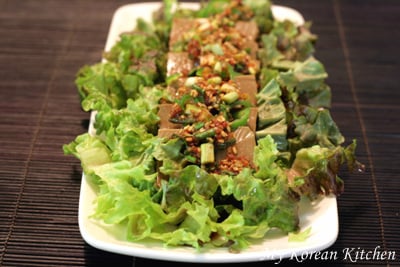
Seasoned Acorn Jelly (Dotori Muk Muchim)

Seasoned Acorn Jelly (Dotori Muk Muchim)1

When I was a child, I sometimes went hiking with my mom and we picked up some dropped acorns in the hills. I didn’t hike to the very top but on the way back the basket of my bicycle was full of acorns. At that time I didn’t know how they could be eaten by us, humans, because I always thought that they are for squirrels.

In my memory, I don’t think I liked the seasoned acorn jelly that much because of its bitter taste, but now I love it, it is like an adult appreciates good food more than a child. It has a slightly bitter taste from the acorn jelly and a slightly sweet and salty taste from the sauce, which I love, and this recipe is like that.

Seasoned Acorn Jelly (Dotori Muk Muchim)2

Hoping you can get the acorn jelly where you live, here is how the recipe goes.

Ingredients (enough to serve 6-8 people as a side dish) : 5 minutes to serve

  • Acorn jelly (도토리묵) – 420 gSeasoned Acorn Jelly (Dotori Muk Muchim) ingredients
  • 2-3 lettuce leaves
  • 1 green chili (non spicy)

Sauce (mix these in a bowl)

  • Soy sauce – 6 tbsp
  • Dark brown sugar – 1 tbsp
  • Sesame oil – 1 tbsp
  • Finely chopped spring onion – 2 tbsp
  • Parched sesame seed – 1 tbsp
  • Chili powder – 2 tsp
  • Minced garlic – 2 tsp

Prep

  1. Slice the acorn jelly (1 cm -1.5 cm thickness).
  2. Take the seeds out from the chili and thin slice it.
  3. Thin slice the lettuce (thickness doesn’t really matter, but mine was close to 1 cm).

Method A) - Better presentationSeasoned Acorn Jelly (Dotori Muk Muchim) method

  1. Put the sliced acorn jelly on the plate.
  2. Add the sliced chili on top.
  3. Decorate the plate with the lettuce.
  4. Spread the sauce on the top.
  5. Serve it on the table.

Method B) - My mom’s way (it may season the acorn jelly and lettuce better)

  1. Put the lettuce, chili and acorn jelly in a mixing bowl.
  2. Add the sauce and lightly mix it.
  3. Serve it on the plate.

Seasoned Acorn Jelly (Dotori Muk Muchim)4

By the way, a pack of acorn jelly is more expensive than tofu (I thought it would be cheap). It was 3,000 won (US $3.20) for 420 g in Korea. I also bought a pack of acorn powder to make acorn jelly from scratch and it was 6,6oo won (US $6. 30). It was requested by one of my readers. I know I really need to make it soon but apparently it requires continuous stirring for nearly an hour without any break, so I gave up for then. :(

Don’t worry! beloved, I will definitely do it. :)

Related Posts

Soy sauce Boiled Tofu (Dubu Ganjang Jorim in Korean)

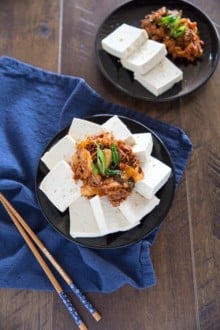
Tofu Kimchi (Dubu Kimchi in Korean)

Simmered Lotus in Soy sauce (Yeon-gn Jorim)

Simmered Lotus in Soy sauce (Yeon-gn Jorim)

Simmered Lotus in Soy sauce (Yeon-gn Jorim) 1

Yeon-gn Jorim is one of my favourite side dishes, and my mom cooks this really well. There are a couple of various ways of cooking lotus and I like the one has a softish chewy texture and sweetish salty taste. Yeah, I know, you have no idea what I am talking about. :) Though if you have ever tried some of this side dish, you understand, right?

Preparation itself is a piece of cake, but it can be a bit of a time consuming process for a single side dish. Mine turned out to be the one that has a sweetish salty taste, but the texture was crunchy. It tasted good (if you prefer a crunchy texture you will love it). Though since I prefer chewy texture I might add extra corn syrup next time, because I think the chewy texture comes from corn syrup, and to get a softish texture, I might need to simmer it a bit longer but I’m not really sure how long it would take me.

Ingredients for 4 people

(Expected Prep time – 3 minutes, Cooking time – 25 minutes)

Simmered Lotus in Soy sauce (Yeon-gn Jorim) ingredients
  • Lotus – 370 g
  • Water – 4 cups
  • Apple vinegar – 1 tbsp

Sauce (mix these well in a bowl)

  • Soy sauce – 5 tbsp
  • Refined rice wine – 4 tbsp
  • Water – 6 tbsp
  • Dark brown sugar – 2 tbsp

Final sauce

  • Corn starch – 1 tbsp
  • Parched sesame – 2 tsp
  • Sesame oil – 2 tsp

Prep

  1. Rinse the lotus in water and scrub off the dirt with a cloth.
  2. Peel the skin with a peeler.
  3. Rinse it once more.
  4. Thin slice it .

Cooking

Simmered Lotus in Soy sauce (Yeon-gn Jorim) cooking
  1. Put the water and vinegar in a pot and add the lotus. Boil it for 20 minutes.
  2. Drain the water and run cold water on lotus.
  3. Put the lotus in a pot and add the sauce. Simmer it on medium heat until the 2/3 of the sauce disappears.
  4. Add the final sauce in the pot, cook it on strong heat for short time.
  5. Serve it on a dish.
Simmered Lotus in Soy sauce (Yeon-gn Jorim) 2

Other food boiled in soy sauce

Soy sauce Boiled Tofu (Dubu Ganjang Jorim in Korean)

Braised Baby Potatoes 1 (Algamja Jorim in Korean)

Boiled Beef and Quail’s Eggs in Soy sauce (Sogogi Jangjorim in Korean)

Seasoned Green Bean Sprouts (Sukju Namul Muchim in Korean)

Seasoned Green Bean Sprouts (Sukju Namul Muchim in Korean)1

I am into these green bean sprouts lately. They give a flavourful taste to soup and a savory taste to side dishes. I don’t make many side dishes (I prefer one dish meals that don’t require any side dishes, because it is simple and quick, and I don’t need to wash many plates later on :) ), but I thought I should try some side dish recipes to show you, since I haven’t made one for a while. So I tried making seasoned green bean sprouts and the more I eat them, the more I like them.

Their flavour comes out with a good balance of salt, garlic and sesame oil. They have a mild taste and chewing their fiber is another pleasure (They give a bit of a soft yet crunchy feeling).

Ingredients for 4 people

(Prep time – 2 minutes, Cooking time – 10 minutes)

  • Green bean sprouts 250 g
  • Salt – ½ tsp
  • Sesame oil – 1 tsp
  • Minced garlic – 1/8 tsp
  • Finely chopped green onion – 2 tsp
  • Parched sesame – 1/8 tsp

Steps

Seasoned Green Bean Sprouts (Sukju Namul Muchim in Korean) steps1
  1. Rinse the green bean sprouts in cold water, discard the bad beans.
  2. Boil some water in a pot. (I used 3 cups of water)
  3. Add the green bean sprouts when the water starts to boil.
  4. Par boil them for 2 minutes.
  5. Drain the water. Cool down the sprouts. (if you lift them with tongs or chopsticks frequently, it cools down faster.)
  6. Add the salt on top (sprinkle it all over the place) and leave it like that for 3 minutes.
  7. Squeeze the green bean sprouts with your hands. (discard the water if it comes out)
  8. Add the rest of the seasoning sauce, and mix them well.
  9. Serve them on a dish.
Seasoned Green Bean Sprouts (Sukju Namul Muchim in Korean) steps2

Side story about “Sukju Namul” (Green bean sprouts)

Seasoned Green Bean Sprouts (Sukju Namul Muchim in Korean)3

Writing about Korean food certainly makes me study. While I was translating sukju namul into English, which was about a month ago, I found that they are called green bean sprouts in English. Green bean sprouts? Are they made of green beans? I didn’t realize that they are made of green beans (apparently I was ignorant about Korean food and its history before I started this blog), because they disguised their name into sukju all this time. Green bean is Nokdu in Korean, then how come Koreans call green bean sprouts Sukju namul instead of Nokdu namul?

Well, apparently, there is a popular traditional theory and most Koreans seem to believe, that is the true. There was a scholar called Shin Suk-ju in 1462, and he betrayed his king when there was a coup (There was a young king called ‘Danjong’, and his uncle ‘Sejo’ tried to take over the throne.) When the coup happened he was asked to help his king, but he refused to do so. Apparently green bean sprouts go off very easily, so their easily changing characteristic is similar to Shin Suk-ju’s mind. That is why Green bean sprouts are named Sukju namul instead of Nokdu namul.

Apparently green bean sprouts are more nutritious than bean sprouts and have 80 times more nutrients than green beans themself.

Related Posts

Spicy Noodles with Green Bean Sprouts (Sukju Ramyun in Korean)

Thinly Sliced Radish Kimchi

Boiled Beef and Quail’s Eggs in Soy sauce (Sogogi Jangjorim in Korean)