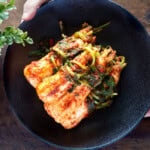
Ponytail Kimchi (Chonggak Kimchi)
Chonggak kimchi (ponytail kimchi) is made with young Korean radishes and their leafy greens, coated in a flavorful kimchi seasoning. The radishes stay crunchy as they ferment, while the greens gradually soften and absorb the seasoning. I especially love serving it with a bowl of warm rice and Korean soup.
Servings: 3.5 -3.5–4 kg (7.7–8.8 lb)
Ingredients
Radish and Brine
- 3 kg chonggak radish (young ponytail radish), (6.6 lb)
- 3/4 cup coarse sea salt
- 2 1/2 cups warm water
- 1 cup Sprite or 7UP, or Korean Chilsung Cider
- 1/2 cup granulated sugar
Seasoning
- 100 g red sweet pointed peppers (or mildly hot Korean red chili peppers for a regular-heat version), (3.5 oz), roughly chopped
- 35 g garlic cloves , peeled, (1.2 oz), or about 2 Tbsp minced garlic
- 120 g red apple , cored and roughly chopped, (4.2 oz)
- 100 g onion , roughly chopped (3.5 oz)
- 1/3 cup maesil-cheong Korean plum syrup
- 1/2 cup paprika powder (unsmoked)
- 1/2 Tbsp gochugaru (Korean red pepper flakes)
- 1 Tbsp saeujeot (salted fermented shrimp)
- 1/2 Tbsp saeujeot (salted fermented shrimp), brine only
- 1/3 cup Korean soup stock
Sweet Rice Flour Paste
- 2 Tbsp sweet rice flour (glutinous rice flour)
- 1 cup Korean soup stock
Final Seasoning
- 60 g green onion , cut into short lengths, (2.1 oz)
- 2 Tbsp granulated sugar
- 2 tsp fine sea salt
- 1/2 tsp minced ginger
Instructions
- Prepare the radishes. Trim away any thin, straggly roots, wilted leaves, and damaged stems. Gently scrape off any stubborn dirt around the radish roots and where the stems meet the radish, taking care not to remove too much of the skin. Wash thoroughly under running water to remove any remaining soil.
- Prepare the brine and salt the radishes. Place the radishes in a large container, with the leafy tops resting above the roots. Sprinkle the coarse salt over the radish roots, then add the warm water, Sprite or 7UP, and sugar. Gently stir to distribute the salt and sugar.Place a clean bowl filled with water on top to weigh down the radish roots, keeping most of the leafy tops above the brine.Let the roots salt for 1 to 1 1/2 hours, turning them after about 1 hour so they salt evenly. Then submerge the leafy tops for another 30 minutes. This gives the roots more time to soften without over-salting the delicate greens.The total salting time should be about 1 1/2 to 2 hours, depending on the size and firmness of the radishes.
- Rinse and drain. Give the salted radishes a quick rinse under cold running water. Drain well in a colander for 20 to 30 minutes.
- Make the sweet rice flour paste. Combine the sweet rice flour and Korean soup stock in a small saucepan, whisking until smooth. Cook over medium heat, stirring continuously, until the mixture thickens into a smooth paste. Remove from the heat and let it cool completely.
- Make the kimchi seasoning. Add half of the fresh red peppers, garlic, apple, onion, maesil-cheong, paprika powder, gochugaru, saeujeot, saeujeot brine, anchovy fish sauce, and cooled sweet rice flour paste to a blender. Blend until fairly smooth.Add the remaining red peppers and pulse briefly, leaving some small pieces for texture.Transfer the mixture to a large mixing bowl. Add the green onions, sugar, fine sea salt, and ginger, and mix well to combine.
- Cut the radishes. Cut the radish roots lengthwise into halves or quarters, depending on their size, to make them easier to eat. Leave smaller radishes whole if they’re already bite-sized.
- Season the kimchi. Add the drained radishes to the seasoning mixture. Gently toss until the radish roots and leafy tops are evenly coated.
- Pack and ferment. Pack the kimchi into a clean fermentation-safe container (we used a 4.8 L / 5.1 qt container), pressing it down gently as you go. Leave some space at the top to allow room for expansion during fermentation.Leave it at room temperature for about 24 hours, then transfer it to the refrigerator to continue fermenting slowly. Enjoy when the kimchi reaches your preferred level of tanginess.
Notes
For a regular-heat kimchi: This recipe uses paprika powder to keep the seasoning mild. For a more traditional Korean kimchi flavor and heat level, replace the 1/2 cup paprika powder with 1/2 cup additional gochugaru. Keep the original 1/2 Tbsp gochugaru in the recipe.
Fermentation and Storage: For this batch, I left the kimchi at room temperature for 24 hours, with daytime temperatures around 22–24°C (72–75°F) and nighttime temperatures around 16–20°C (61–68°F), before transferring it to the refrigerator.
I prefer eating it after another 4–5 days, when the radishes are still crunchy with just a little tanginess. My mom prefers a more developed, tangier flavor, so she likes it after about 13 days in the refrigerator.
For faster fermentation, transfer a small portion to a separate fermentation-safe container and leave it at room temperature a little longer before refrigerating. This also works if your refrigerated kimchi is taking longer than you'd like to become tangy.
Fermentation speed varies depending on the temperature, so adjust the timing to your taste.