Published May 29th, 2007
in Noodles and Vegetarian.

This bibim guksu is something I am very much enjoying making and eating lately. I made this 5 times last week already. Yes! it is that tasty and morish. I just can’t get sick of it. Besides, it doesn’t require any complicated preparation or cooking.
Its main taste comes from the sauce, which has a slightly spicy, sweet and sour taste, and the fragrance from the sesame oil is another pleasant experience.
Bibim guksu is a popular Korean summer dish, because the spicy and sour taste rejuvenates your lost appetite in drowsy hot humid summer days. For me, looking at this picture is good enough for now. How about you?

Ingredients for 2 people (Ready in 10-15 minutes)
Noodles
- 180 g organic soba noodles
Toppings
- 2 medium lettuce leaves, thin sliced
- 1/4 a leaf red cabbage, thin sliced
- 1/2 a small cucumber, julienned
- 1/3 a small carrot, julienned
- A few snow pea sprouts
- 2 tbsp thumb nail size Kimchi
Sauce (mix these in a bowl)
- 2 tbsp gochujang
- 2 tbsp rice vinegar
- 1 tbsp soy sauce
- 1 tbsp honey
- 1 tbsp brown sugar
- 1 tbsp Korean sesame oil
- 1 tbsp roasted sesame seeds
Method
- Boil the noodles in boiling water for about 3 minutes.
- Sieve the noodles and run the cold water thoroughly over the noodles to cool them down.
- Place the noodles in a bowl and add the toppings and sauce.
- Mix them well and dig in.
Cook’s Note
You can alter the toppings as you wish, like adding boiled egg or white radish pickle etc. Also if you want more spicy taste, you may add some Korean chili powder or minced garlic in the sauce and more vinegar for a sour taste. However, before you add anything into the original sauce, make sure you taste it first to ensure it tastes good.
The noodles I used for this recipe

HAKUBAKU organic soba (ingredients : wheat flour 69%, buckwheat flour 29%, salt 2 %, water), Price - about AU $2.30, available at Woolworth or Coles
The noodles are conveniently divided into 3 portions with white paper straps.
bibim guksu, Korean Food, Noodles, soba noodles, Vegetarian
Published May 27th, 2007
in Picture of the week.

(Photo from http://www.munhwa.com)
I started this “picture of the week” thing from last week.
I go through lots of Korean publications on the internet to find “That Korean Food Picture”, which grabs my attention. It is to engage you with some awesome Korean food that is made by an expert.
Today’s picture is grilled spicy pork and lots of side dishes. The pork looks quite spicy (mainly seasoned with Korean chili powder) yet the meat grilled straight on the fire fire is truly tasty!
Picture of the week
Published May 25th, 2007
in Korean Food F.A.Q.

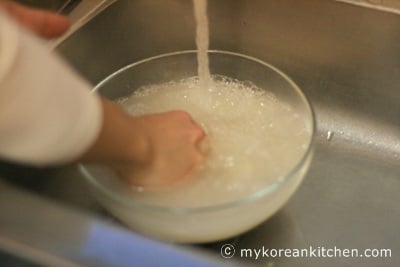
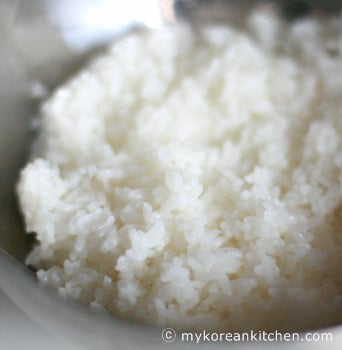
After rinsing the rice properly, we need to soak the rice in water.
The reason is to make evenly cooked rice and to make each rice grain sticky and resilient (”gelatinization”). However if you soak it too long, it can become brittle and lose some nutrition. So we need to do it for the right amount of time. Then what is the right amount of time?
-V How long to soak the rice-
- Soak the rice in water for 30 minutes in summer and 1-2 hours in winter minimum.
(The temperature is based on the Korean climate ; Seoul’s average daily high temperature - summer : 27℃, winter : 3℃)
Once the soaking is done, we can finally start boiling.
First we need to add an adequate amount of water to the rice. The adequate amount can vary depending on the the type of rice, condition of the rice and type of cooking method, but we usually need to add 1.5 times more water compared to the rice weight or 1.2 times more water compared to the rice volume.

(However, I always measure it manually. The so called “Knuckle method” - Add the water until it covers near my knuckles when my hand is flat on the rice. Does it sound logical to you? A lot of Koreans seem to use this method too. It’s not just me.
)
The rice cooking process goes Boiling - Simmering - Thoroughly steaming. If you use an electric rice cooker like I do, we just put the rice and water into the cooker and press the button. However if you use the stove top method then there are a couple of things you need to be aware of.
-V How to cook Korean steamed rice on the stove-
:Recommended by a rice expert in the Rural Development Administration (Korean government)
- Boil the rice for 5-10 minutes on high heat (The water gets absorbed into the rice and the rice expands).
- Turn the heat down to medium and simmer it for 7-8 minutes (During this time we are accelerating the gelitinization process - making each rice grain sticky and resilient).
- As the water gets absorbed into the rice or evaporates, reduce the heat to low gradually. Do not open the lid at this point. When the water has nearly disappeared, turn the heat off.
- Let the rice sit (thoroughly steam) for 10-15 minutes with the lid on.
- Then stir the rice around (top to bottom, side to side) lightly with the rice scoop (It is to evaporate extra moisture, even out the rice taste, and keep the good shape).
Now, theoretically, we should be able to make perfect Korean steamed rice. Fingers crossed for you all!
Comments
If you are interested in buying a Korean rice cooker, you can try Hmart online shop. They seem to sell the top brand Korean rice cooker “Cuckoo” and I am using one of their models. Or if you are interested in buying a Japanese brand like zojirushi you can try amazon
electric rice cooker, how to cook the Korean rice, Korean Food F.A.Q