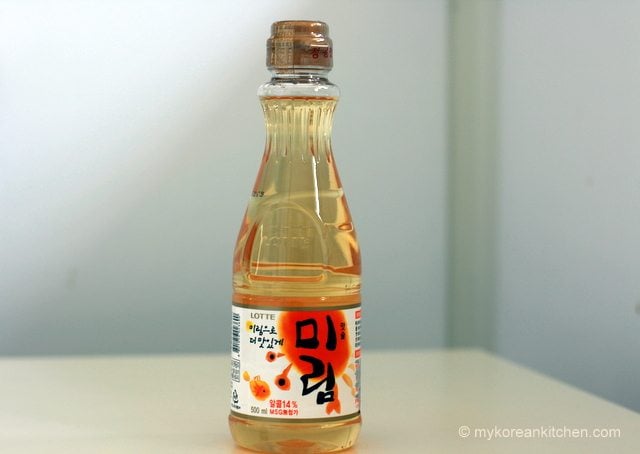
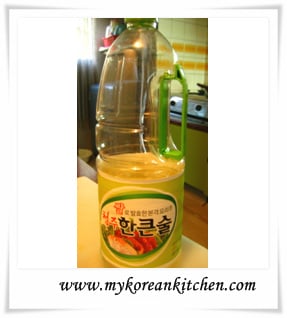
White wine for fish and chicken (left) and Red wine for red meat (right)
Koreans use refined rice wine fairly often for their cooking, including myself. It gets rid of the smell of meat and adds a refreshing taste to certain foods.
So I went looking for refined rice wine to add to our meal for the day. I went to a supermarket. Ah, wait a minute. I can’t get it at the supermarket like I could in Korea. So I went to a liquor store.
Of course I asked the wrong question and asked for cooking wine, and was given a red merlot and a white chardonnay. It cooked well with the meals, but I should have asked for the refined rice wine instead.

So I gave it a second try. This time the guy was puzzled until I said “like sake”.
Now I have found rice wine (It was Japanese sake), but at $27 Australian for 750ml compared to $8 for 1800ml in Korea I might have to rethink my recipe list.
Nothing is ever perfect, is it?

Chicken breast - I was going to use white wine for this, but I didn’t have a cork screw

Meal of the day - Club sandwich ( filling includes iceberg lettuce, baby endive, tomato, cheese and chicken fillet)
I will still try to find refined rice wine (a cheaper one) but if I can’t find it, I guess I have to stick with a red and white wine. How are you following my recipes about the refined rice wine? Do you use other wines instead? What is your cooking wine?


I don’t like to overlap cuisine with ingredients: Western-aged wines for western food only and rice wine for the east. I’ve been using sake in place of refined rice wine (seems to work well) and I have also heard that mirin gets rid of red meat smell.
The sandwich looks scrumptous! However, I don’t think wine would go well with the chicken breast. Good luck!
I wonder if you might have more success with Chinese cooking wine, e.g. Shaoxing cooking wine — much, much cheaper than sake and available at most Chinese supermarkets.
Oh, but I’d probably just use a little olive oil salt/pepper for the chicken breasts.
In the US cooking wine is often labeled “not for drinking,” making it legal to sell in places that don’t sell alcohol otherwise. Assuming the situation is similar in Australia, I’d try looking either in the Ethnic/Asian section of the grocery store or with the vinegar and cooking sherry.
I am Korean and I never use the cooking wine. I just leave the chicken alone - rinse and pat dry and sprinkle some salt and pepper to it. I just never had the need to use the wine at all in my Korean cooking (my mom never uses it either) and it always tastes great!
Harvey, I agree with you, though I think adding something alternative is better than adding nothing (Since I am in Australia now, I can’t get all the Korean ingredients, especially fresh groceries that I used to use. I suppose the food I make will be Korean fusion). Of course it comes down to an individual’s preference.
And I know what mirin does. There is even a very similar brand to mirin in Korea too and I can even get it in Australia. But I prefer not to use it. I think it has a fair bit of artificial extra ingredients in it. But thanks for your suggestion.
Sheena, Thanks. I might consider that Shaoxing cooking wine. Is it pretty natural?
Matie, Actually before I went to the liquor store I spent nearly half an hour searching for cooking wine at the supermarket. I checked the shelves you mentioned two times, I just couldn’t find it.
Janet, That is very surprising! Because I’ve never heard of anyone never using rice wine before. When I look up Korean recipes on the internet (either professional or none professional websites) or even a cookbook, there are at least more than 10 recipes that use rice wine in each book. I am sure food taste great without the rice wine, but my personal opinion is that certain food tastes even better with it (Though it might be really a minor difference, yet it seems big to me.
) It is up to the individual’s taste of course.
I think you can find cheap Gekkeikan or Ozeki brand Japanese sake if you look around a bit… It’s not very good for drinking, though many people drink it hot in the US, so I just use it for cooking.
Sometimes I swap Western and Asian “wines” and sometimes use sherry/vermouth in Chinese dishes. For Korean food, I think inexpensive brands of sake will work best usually, but it is interesting to see how dishes change with a grape-based wine instead of rice wine.
In Seattle, Japanese sake is about 2-3 times as expensive as the same level of quality in Japan. Soju and Korean wines are about 5 times the Korean retail price… maybe shipping costs are a big factor, and maybe per liter import taxes. However, we can still find many ordinary Korean wines for USD $5-6 for small, 375 ml bottles… pricy by Korean standards for that level, but not bad here.
This may seem obvious but have you looked for sake and soju at specifically Japanese markets. Wine shops generally don’t know asian spirits and drinks so you might have better luck in a specificaly Japanese supermarket or grocery. In Los Angeles they all have inexpensive 4$ish 300ml bottles of the palatable Hakutsuru sake. What you paid for was probably better sake than you need for cooking.
Sheena/Sue - I sometimes use Shaoxing wine in marinades for Chinese stir-fries (e.g., chicken, red meat). It deepens the stir-fry but also leaves a slightly sweet taste afterwards. Although I prefer refined rice wine or mirin for a cleaner taste, I suppose Shaoxing could work as well.
Sue - I definetely agree; overlapping ingredients across culinary boundaries is better than nothing. Maybe I’m just too much of a purist.
I use cooking rice wine (sake) for anything that needs wine or rice wine in it. Seems to work alright. I have heard that if you do cook with wine, you should use one that you would be willing to drink too. Good luck!
I’ve actually been using rice vinegar. I think it has a sweet clear taste.
Wine isn’t part of my culture, but I use Japanese cooking wine, whenever I need a good rest. Because apparently even a little bit of alcohol knock me down. I bought it in Daiso, a japanese store, 2 SG$ for 300 ml. Quite cheap, probably because of the low alcohol level. Less than 20% from normal cooking wine.