Monthly Archives: April 2007

Omelet Rice (Omurice)

Omelette Rice (Omurice)1

I often feel like cooking something very simple without taking much effort, yet want to pretend that I spent some good time on it. Do you ever feel the same way? Then this omelet rice might come in handy. In fact, I cooked it 4 times in the last week already.

Michael was very intrigued how I cover the rice with the eggs so well. Although dicing vegetables can be a little annoying and the most time consuming part of the process, it is quite simple to make. Would you like to pretend too?

Ingredients – 2 servings

  • 1/2 (50 g) carrot
  • 1/2 (80 g) onion
  • 1/3 (40 g) red capsicum
  • 80 g smoked ham
  • 100 g crab stick
  • 3 tbsp tomato sauce
  • 1 tbsp worcestershire sauce
  • 4 eggs
  • A pinch of salt
  • 2 cups steamed rice
  • Some rice bran oil
  • Some tomato sauce

Method

-Stir frying rice (You will need a wok)

Omelette Rice (Omurice)3

  1. Dice carrot, onion, red capsicums, ham and crab stick.
  2. Mix the tomato sauce (3 tbsp) and worcestershire sauce in a bowl.
  3. Pre heat the wok on high heat for 10 seconds and add some oil.
  4. Add all diced ingredients and saute for 1 minute.
  5. Reduce the heat to half.
  6. Add the steamed rice and the mixed sauce. Mix them well for 30 seconds.
  7. Stop the heat.

-Omelet

  1. Beat two eggs in a bowl and add a pinch of salt.
  2. Heat a frying pan and add some oil. Pour the egg in the frying pan.
  3. Quickly spread the egg and make a thin, large, and round omelet.
  4. Repeat step 1 to 4 for the rest of the eggs.

Omelette Rice (Omurice)4

-Shaping (You will need two deep bowls and two plates)

  1. When the omelets are made, place them in deep bowls.
  2. Put the stir fried rice on top of each omelet.
  3. Put the plate on top of the bowls. Turn them up side down and remove the bowl.

-Decoration

  1. Make a cross cut on top of the omelets and add some tomato sauce on top.
  2. Enjoy!

Omelette Rice (Omurice)2

Steamed Cabbage Rice Wraps (Yangbaechu Ssambap)

Steamed Cabbage Rice Wraps (Yangbaechu Ssambap)1

It’s Autumn here in Australia. But still in my mind April means spring, with lots of beautiful flower blossoms and also more fresh herbs to make Namul banchan (seasoned vegetables or herbal side dishes) or Ssam (wraps) – in Korea that is.

Are you familiar with Ssam? Ssam means any wrapped food in edible leaves or wet seaweed like kombu. If you had meat in lettuce at a Korean restaurant that is called Ssam as well.

One type of Ssam I love is Ssambap (쌈밥). Ssambap is wrapped rice in edible leaves or some leafy seaweed. It is known as a healthy diet meal, because lettuce (or cabbage) makes you feel satisfied sooner. However, the material that is contained in lettuce, called lactcarium, can make you sleepy after the meal, so we need to watch out for that.

There are also some Korean restaurants specializing in Ssambap. They have a menu called “Ssambap Jeongsik” (consider this as Ssambap combo) which includes various kinds of leaves with dipping sauce, several side dishes, soup or stew and Jeyuk bokkum (stir fried spicy pork). Man, my mouth starts to water thinking of these already.

Steamed Cabbage Rice Wraps - Jeyuk Bokkum

(Homemade Jeyuk Bokkum – January 2007 )

The key point of making delicious Ssambap is making delicious Ssamjang, the dipping sauce. Every restaurant has their own secret recipe for this. Me? I don’t have a secret recipe, I am not a specialist at this. However I found a simple and interesting recipe from the free recipe book that came with a magazine.

The dipping sauce turned out sweet but also a bit spicy. But to be honest, it might go better as a Bibimbap sauce rather than as a dipping sauce. Yet give it a try! You never know how you might feel about it.

Ingredients

-Cabbage wraps (for 2 people)

  • 600g steamed cabbage
  • Steamed plain rice

-Ssamjang (enough to serve 6-8 people)

  • 1 cup of Korean chili paste (Gochujang)
  • 100g beef mince
  • 1 tbsp sesame oil
  • 4 tbsp grated Nashi pear (or Korean pear)
  • 1 tbsp sesame oil
  • 1 tbsp brown sugar
  • 2 tbsp honey

-Marinade sauce for beef mince (mix these well)

  • 1 tsp soy sauce
  • 1 tsp brown sugar
  • 1 tsp minced garlic
  • 1 tsp sesame oil
  • 2 tsp minced green shallots
  • little ground black pepper

Method

Steamed Cabbage Rice Wraps (Yangbaechu Ssambap)2

  1. Marinade the beef mince with the marinade sauce, leave it for 5 minutes.
  2. Pre heat the wok on high heat for 10-20 seconds then add 1 tbsp of sesame oil in the wok.
  3. Add the marinade beef and stir it fast.
  4. When the meat is nearly cooked add the pear and stir it.
  5. Add the Gochujang and stir it occasionally for about 6-10 minutes on medium heat.
  6. Add the sesame oil, sugar, and honey, then stir.
  7. Turn the heat off.
  8. Serve the Ssamjang (dipping sauce) with steamed cabbage and rice or you can make the roll then serve.

Note : When you serve the Ssamjang, you should scoop out an adequate amount for the size of the meal. You can store the rest of the sauce in a sealed container in the fridge. It should last for at least a month.

Related Post

Stir Fried Gochujang and Simple Bibimbap

Some recipes for Ssambap combo

-Side dishes

Thinly Sliced Radish Kimchi

Fish Cake Stir Fry (Eomuk-Japchae in Korean)

Simmered Lotus in Soy sauce (Yeon-gn Jorim)

Seasoned Green Bean Sprouts (Sukju Namul Muchim in Korean)

-Soup

Tofu Soybean Paste Stew (Dubu Doenjangjjigae in Korean)

Pork and Kimchi Stew (Dwaejigogi Kimchijjigae in Korean)

-Meat

Marinatied Pork Stir Fry with Gochujang sauce (Jeyuk-bokkeum)

Simple Steamed Eggs (Gyeran Jjim)

Simple Steamed Eggs (Gyeran Jjim)4

I don’t like receiving phone calls around meal time, especially when I am busy preparing food. It might sound strange but I believe the more attention the food gets, the tastier it gets. Unfortunately I was on the phone while the eggs were steaming in the pot. It was my sister from Korea, you know what happens then. The long chit chat and giggles.

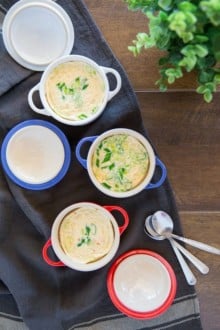
Nevertheless, I couldn’t concentrate much on the conversation. My mind was with the steaming eggs. Hang up, sis! I need to check my babies. I returned to the kitchen. Da da~! I opened the lid and I saw real gems in pretty cups. I didn’t expect the eggs to rise yet they looked so adorable!

Simple Steamed Eggs (Gyeran Jjim)3

I think the eggs have a joker face. You never know what it is going to be until you serve it. Do you agree? I was so happy to see the well transformed eggs but slightly sad that I missed how they transformed. I hope you don’t miss this.

Simple Steamed Eggs (Gyeran Jjim)1

Ingredients (to serve 3 people)

  • 6 large eggs (~70g each)
  • 15cm by 15cm kombu (dried seaweed)
  • 1 cup of warm water
  • 2 tbsp anchovy sauce
  • 1 stalk of finely chopped shallot (green part only)
  • 1/3 of finely chopped medium size carrot

Prep

  1. Soak the kombu in warm water for 15 minutes.
  2. Beat the eggs and sieve them two times.
  3. Add the kombu water into the beaten eggs (discard the kombu).
  4. Add the anchovy sauce, shallots, and carrot.
  5. Mix them well.
  6. Pour the egg mixture into bowls (up to 80% of the bowl) and cover them with plastic wrap.

Simple Steamed Eggs (Gyeran Jjim) steps

Method (It makes it easier if you have a big steamer)

  1. Boil the water in a steamer (high heat).
  2. When the water starts to boil, add the bowls.
  3. Lower the heat to medium to low, steam the bowls for about 15-20 minutes.
  4. Serve them.

Simple Steamed Eggs (Gyeran Jjim)2

The raised eggs sink slightly as time passes. Though they still look pretty. It was a perfect match with plain rice. Michael thinks it can be a good entree as well. However eating it on its own can be salty, so you might want to reduce the amount of anchovy sauce to 1 tbsp if you don’t like too much salt taste.

For a variation, you can add other kinds of vegetables or even some meat. I will do another post with those some other time. In the mean time, I also think plain steamed egg would be a good baby’s formula.

Simmered Meat Patties in Teriyaki like sauce – Jangsanjeok

Simmered Meat Patties in Teriyaki like sauce - Jangsanjeok1

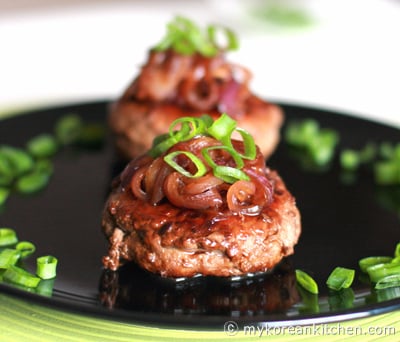
What is Jangsanjeok (장산적)? As the title describes, it is broiled meat patties (these are called Seopsanjeok) that are simmered in teriyaki like sauce. Well, it may not look like traditional Korean food from the picture (Michael keeps saying that it looks like a rissole), but it is a Korean food. I gave it a slightly different look, which I want to call “fancy”, whether you want to agree or not. I also added extra ingredients for the sauce compared to the traditional methods that were served to the Kings of the Chosun dynasty.

You can serve Jangsangjeok as a side dish, as a main meal, as a filing for a burger or at a BBQ. It is quite convenient, in that unlike other kinds of side dishes it can be frozen, so you can preserve it for later.

Simmered Meat Patties in Teriyaki like sauce - Jangsanjeok2

Ingredients

For patties (enough to make 8-9 round patties, with a diameter of 9cm)

  • 440g beef mince
  • 440g pork mince
  • 190g tofu (squeeze it in a straining cloth to drain the water)
  • 6 tbsp finely chopped onion
  • 2 tbsp finely chopped shallots
  • 2 tbsp Korean sesame oil
  • 1 tsp minced garlic
  • 1 tsp fine sea salt
  • 1/4 tsp ground black pepper

For sauce (for 4 patties) – mix the following in a bowl

  • 3 tbsp soy sauce
  • 3 tbsp red wine
  • 1 tbsp brown sugar
  • 1 tbsp honey
  • 1/4 tsp ginger powder

Optional

  • 1/2 thin sliced onion
  • 1/2 stalk of chopped shallots (green part)

Prep

Simmered Meat Patties in Teriyaki like sauce - Jangsanjeok3

  1. Add all the patty ingredients in a big bowl then mix it well.
  2. Think how big you want to make the patty first (in my case, I aimed at medium size patties and got 8 of them) then knead the patty to the size you want.
  3. Leave the patties out that you are going to cook and seal the rest of the patties with plastic wrap and store them in the freezer.

Method

Simmered Meat Patties in Teriyaki like sauce - Jangsanjeok4

Part 1 (You will need a frying pan)

  1. Pre heat the frying pan on high heat.
  2. When it is heated enough, add some oil (I started using rice bran oil and it works great).
  3. Add the patties and cook both sides on high heat for a short while.
  4. Reduce the heat to medium to low and cook the inside of the patty.

Part 2 (You will need a sauce pan)

  1. Pre heat the sauce pan.
  2. Add the bowl of sauce and onion.
  3. Stir it a little bit then add the patties.
  4. Simmer them well.
  5. Serve them on the plate (if there is any sauce left, pour it out on top of the patties – it is tastier).

Some products I used for this recipe

Simmered Meat Patties in Teriyaki like sauce - Jangsanjeok5

Related Posts

BBQ Grill Plate

Royal Rice Cake (Gungjung Ddeokbbokki in Korean)

What Kind of Camera Do I Use?

Many people have been asking me what kind of camera I use here and there on this blog. I want to take this as a compliment that my photos are good, so you want to use the same camera. (Or did you mean that they are awful, so you want to avoid using the same camera? :) )

Instead of answering lots of individual questions about my camera, I decided to give one full answer to this matter.

Currently, I am using a Canon Digital Rebel XTi 10.1MP (Canon EOS 400D or Canon Kiss digital X in some other countries) with a Canon EF 50mm f1.4 USM lens.

And here are some collages of pictures I personally think are my best, using my equipment. You will see how the camera (with the right lens) and natural light makes a difference.

What Kind of Camera Do I Use 1

(under natural light)

For the record, I started using the Canon Digital Rebel XTi 10.1MP for this blog from this post (ddeokbokki recipe). Before that I used a Canon PowerShot S45 . It turned out OK sometimes, but I did a lot of work to get more light with an extra lamp.

Some good photos from the Canon PowerShot S45

What Kind of Camera Do I Use 2

(under artificial light)

Using an SLR camera with my lens is definitely my life saver. It reduces the hassles of getting light and saves time. I also get better and more satisfying results.