(William Pears – Sorry, I don’t think you are suitable for Korean cooking)
One of my readers asked me if I can specify the type of pear I use for making Bulgogi. Because my recipe just says “pear”. Well, since I could only get one type of pear in Korea (It might be different in other big cities, but at least that was my case) I didn’t understand your confusion. Sorry.
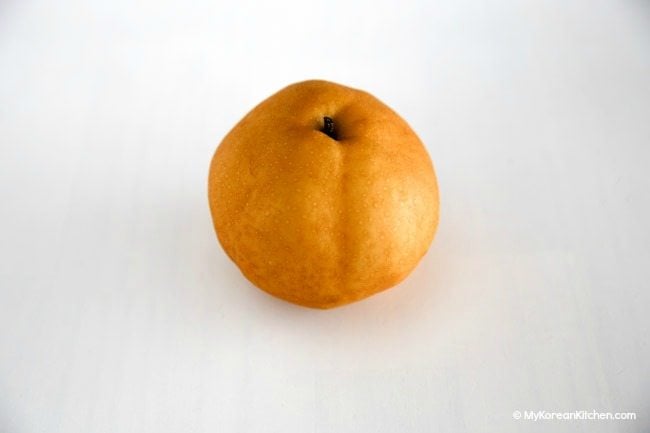
So this is the type of pear you can use for Korean cooking.

(Korean pear, picture from Food for thought)
Its skin is a bit rougher and thicker, so you don’t eat the skin. However the flesh part is marvelously juicy (but not as much as watermelon) and sweet and has a crunchy texture like an apple. They are fairly expensive even in Korea, so I didn’t buy them often (about US $2-3 per pear).
Koreans usually add pear when they marinate meat. Because it makes meat softer (Apparently the enzyme called calpain does this part). You can substitute pear with kiwi or pineapple as well, but I prefer using pear. Also, if you marinate the meat too long the meat can go too soft, so watch out.
I heard that Korean pears are available at the green groceries in the US, but since I don’t live there I can’t give you the detailed information about them. So if any of you see Korean pears where you live (in any countries), please let us know (for your Korean food companions).
By the way, if you are in the US, it seems like you can buy Korean pears on the internet as well.


My grandmother always used kiwi in her bulgogi sauce and it turned out fantastic. I’ve seen asian pears (the kind pictured) in the larger supermarkets in the U.S., though. They are a tad on the pricier side, but I’ve also heard bosc is a good substitute. I’ve made my sauce before with just rice vinegar or mirin to tenderize the meat, but I’ll admit it wasn’t as good as with fruit.
The recipe for bulgogi my mother brought back from Korea uses no pears. It doesn’t use any fruit. It’s also the best bulgogi we’ve ever had and we compare all bulgogi to that recipe.
As for korean pears (or pear-apples as we grew up calling them), we always ate the skin.
I’ve never had pear in Bulgogi, the Korean cooks I’ve known have always used honey to temper the bitterness of Sesame Oil, or mixture of other ingredients. However, I think a good substitute for asian (Korean) pears would be Bosc pears. They are crisp, juicy and sweet, as long as they don’t sit around too long. My Korean sister Su’s husband can’t keep his sticky fingers out of her marinating Bulgogi, he prefers to eat it raw after marinnating over night, and he is a good judge as to wether or not it needs more sweetness to cover the bitterness.
Try subsituting honey for sugar or other sweetners in Bulgogi, it’s healthier and gives a better flavor!
If I was a single man, I could get lost in Korea just traveling around from village to village and sampling all the different varieties and variations of Korean foods.
These pears called Nashi, I think, can be found in almost any big supermarket in France recently…I don’t exactly know the period of the year… But they should be found in the exotic fruits section.
The first one I bought here was wonderful, really juicy, sweet, and had kind of a rose taste…However, the one I’ve tasted in Korea seemed to taste almost nothing?? Maybe not mature enough?
I will have to give this another try when it is pear season here. Japan’s “21st century pear” looks like the Korean version.
Fran, It’s good to hear you have had good results from other pears as well. I only mentioned the meat softening part because that is the main purpose. However also because of its sweet taste, I definitely use less sugar than I could have.
I usually use the Asian (Nashi) pear, although sometimes I will substitute
golden delicious or fuji apple. If you use the fuji, you can decrease sugar or corn syrup if you use those in your recipes.
I myself think Asian pears are sweeter and more suitable for use in bulgogi
I’ve made Bulgogi using William pears and it was perfectly fine. If pears are used in the Bulgogi recipe, it is – like you said – as a way to soften the marinated meat, not to flavor it. So I think any pear should do, really. It’s more a matter of texture, not taste.
And these pears are the yummiest around! Korean fruit is so delicious! I just bought one today for 2000 won. Expensive yes, but worth every bite!
I’ve bought Asain pears at Costco before, and some times the regular grocery stores here will have them, but they are expensive and smaller than what I would get at a Korean grocery store.