Category Archives: Rice

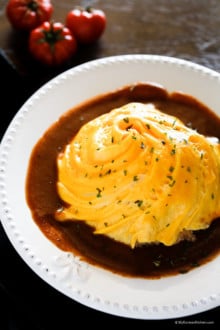
Omelet Rice (Omurice)

Omelette Rice (Omurice)1

I often feel like cooking something very simple without taking much effort, yet want to pretend that I spent some good time on it. Do you ever feel the same way? Then this omelet rice might come in handy. In fact, I cooked it 4 times in the last week already.

Michael was very intrigued how I cover the rice with the eggs so well. Although dicing vegetables can be a little annoying and the most time consuming part of the process, it is quite simple to make. Would you like to pretend too?

Ingredients – 2 servings

  • 1/2 (50 g) carrot
  • 1/2 (80 g) onion
  • 1/3 (40 g) red capsicum
  • 80 g smoked ham
  • 100 g crab stick
  • 3 tbsp tomato sauce
  • 1 tbsp worcestershire sauce
  • 4 eggs
  • A pinch of salt
  • 2 cups steamed rice
  • Some rice bran oil
  • Some tomato sauce

Method

-Stir frying rice (You will need a wok)

Omelette Rice (Omurice)3

  1. Dice carrot, onion, red capsicums, ham and crab stick.
  2. Mix the tomato sauce (3 tbsp) and worcestershire sauce in a bowl.
  3. Pre heat the wok on high heat for 10 seconds and add some oil.
  4. Add all diced ingredients and saute for 1 minute.
  5. Reduce the heat to half.
  6. Add the steamed rice and the mixed sauce. Mix them well for 30 seconds.
  7. Stop the heat.

-Omelet

  1. Beat two eggs in a bowl and add a pinch of salt.
  2. Heat a frying pan and add some oil. Pour the egg in the frying pan.
  3. Quickly spread the egg and make a thin, large, and round omelet.
  4. Repeat step 1 to 4 for the rest of the eggs.

Omelette Rice (Omurice)4

-Shaping (You will need two deep bowls and two plates)

  1. When the omelets are made, place them in deep bowls.
  2. Put the stir fried rice on top of each omelet.
  3. Put the plate on top of the bowls. Turn them up side down and remove the bowl.

-Decoration

  1. Make a cross cut on top of the omelets and add some tomato sauce on top.
  2. Enjoy!

Omelette Rice (Omurice)2

Steamed Cabbage Rice Wraps (Yangbaechu Ssambap)

Steamed Cabbage Rice Wraps (Yangbaechu Ssambap)1

It’s Autumn here in Australia. But still in my mind April means spring, with lots of beautiful flower blossoms and also more fresh herbs to make Namul banchan (seasoned vegetables or herbal side dishes) or Ssam (wraps) – in Korea that is.

Are you familiar with Ssam? Ssam means any wrapped food in edible leaves or wet seaweed like kombu. If you had meat in lettuce at a Korean restaurant that is called Ssam as well.

One type of Ssam I love is Ssambap (쌈밥). Ssambap is wrapped rice in edible leaves or some leafy seaweed. It is known as a healthy diet meal, because lettuce (or cabbage) makes you feel satisfied sooner. However, the material that is contained in lettuce, called lactcarium, can make you sleepy after the meal, so we need to watch out for that.

There are also some Korean restaurants specializing in Ssambap. They have a menu called “Ssambap Jeongsik” (consider this as Ssambap combo) which includes various kinds of leaves with dipping sauce, several side dishes, soup or stew and Jeyuk bokkum (stir fried spicy pork). Man, my mouth starts to water thinking of these already.

Steamed Cabbage Rice Wraps - Jeyuk Bokkum

(Homemade Jeyuk Bokkum – January 2007 )

The key point of making delicious Ssambap is making delicious Ssamjang, the dipping sauce. Every restaurant has their own secret recipe for this. Me? I don’t have a secret recipe, I am not a specialist at this. However I found a simple and interesting recipe from the free recipe book that came with a magazine.

The dipping sauce turned out sweet but also a bit spicy. But to be honest, it might go better as a Bibimbap sauce rather than as a dipping sauce. Yet give it a try! You never know how you might feel about it.

Ingredients

-Cabbage wraps (for 2 people)

  • 600g steamed cabbage
  • Steamed plain rice

-Ssamjang (enough to serve 6-8 people)

  • 1 cup of Korean chili paste (Gochujang)
  • 100g beef mince
  • 1 tbsp sesame oil
  • 4 tbsp grated Nashi pear (or Korean pear)
  • 1 tbsp sesame oil
  • 1 tbsp brown sugar
  • 2 tbsp honey

-Marinade sauce for beef mince (mix these well)

  • 1 tsp soy sauce
  • 1 tsp brown sugar
  • 1 tsp minced garlic
  • 1 tsp sesame oil
  • 2 tsp minced green shallots
  • little ground black pepper

Method

Steamed Cabbage Rice Wraps (Yangbaechu Ssambap)2

  1. Marinade the beef mince with the marinade sauce, leave it for 5 minutes.
  2. Pre heat the wok on high heat for 10-20 seconds then add 1 tbsp of sesame oil in the wok.
  3. Add the marinade beef and stir it fast.
  4. When the meat is nearly cooked add the pear and stir it.
  5. Add the Gochujang and stir it occasionally for about 6-10 minutes on medium heat.
  6. Add the sesame oil, sugar, and honey, then stir.
  7. Turn the heat off.
  8. Serve the Ssamjang (dipping sauce) with steamed cabbage and rice or you can make the roll then serve.

Note : When you serve the Ssamjang, you should scoop out an adequate amount for the size of the meal. You can store the rest of the sauce in a sealed container in the fridge. It should last for at least a month.

Related Post

Stir Fried Gochujang and Simple Bibimbap

Some recipes for Ssambap combo

-Side dishes

Thinly Sliced Radish Kimchi

Fish Cake Stir Fry (Eomuk-Japchae in Korean)

Simmered Lotus in Soy sauce (Yeon-gn Jorim)

Seasoned Green Bean Sprouts (Sukju Namul Muchim in Korean)

-Soup

Tofu Soybean Paste Stew (Dubu Doenjangjjigae in Korean)

Pork and Kimchi Stew (Dwaejigogi Kimchijjigae in Korean)

-Meat

Marinatied Pork Stir Fry with Gochujang sauce (Jeyuk-bokkeum)

Stir Fried Gochujang and Simple Bibimbap

Stir Fried Gochujang1

Today’s post is about a multi purpose condiment “stir fried gochujang”(볶은 고추장). I made this about 3 weeks ago, and since then every time I don’t feel like accomplishing my kitchen duty, it has been a great help. Busy working ladies and gentlemen would love to have this in their fridge, especially if you love Bibimbap. Do you like the idea so far? :)

Stir fried gochujang is literally stir fried gochujang and you add it on some cooked red meat (pork or beef mince) and cook them together a bit . Once you make fair amount of it, you can store it in the fridge for up to 2-3 months. You can use it as a dipping sauce for wrapped meat in lettuce or ddeokbokki sauce or bibimbap sauce.

In my case, I used it as a bibimbap sauce and it was very convenient indeed.

Stir Fried Gochujang4

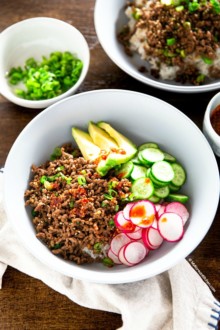
(My simple Bibimbap – rice with stir fried gochujang and radish sprouts)

Ingredients (as a 15 serving bibimbap sauce)

  • Gochujang – 3/4 cup
  • Honey – 1 tsp
  • Water – 3 tbsp
  • Minced pork or beef – 200 g
  • Sesame oil – 1/2 tsp

Sauce for the pork (mix these in a bowl)

  • Soy sauce – 1/2 tsp
  • Refined rice wine (cooking wine) – 1 tsp
  • Minced garlic – 1/2 tsp
  • Ginger powder – 1/4 tsp
  • Pepper – 3 sprinkles

Steps

Stir Fried Gochujang steps

  1. Rinse the pork in cold water.
  2. Marinate the pork with the sauce and leave it for 5 minutes.
  3. Pre heat the wok and add the sesame oil.
  4. Add the pork and stir it well so the meat doesn’t clot.
  5. Add the gochujang, honey, water and stir it well.
  6. Turn the heat off in 3 minutes.

Stir Fried Gochujang3

I keep it in a container in the fridge, with the lid on of course (You need to cool it down, before you put it in).

Stir Fried Gochujang2

Related Posts

Yangpun Bibimbap

Stir Fried Rice cake with Gochujang Sauce (Ddeokbokki in Korean)

Sugar High, Stir Fried Rice Cake and Noodles (Rabokki in Korean)

Sugar High, Stir Fried Rice Cake and Noodle (Rabokki in Korean)

I got shocked as soon as I stared at my face in front of the bathroom mirror in the morning. There were lots of traces of the battle between my skin and hormones, and it seemed like the hormones won in the battle called “Sugar high”. I had lots of pimples here and there, because I had consumed too much sugar yesterday. My sister said my face looks like it was bitten by swarms of mosquitoes all night. :(

Yes, when you having some sweets, you really enjoy the moment. You feel good, become active, cheerful, then a bit violent, cranky, moody, then peace comes finally, and the next day, the glory of pimples.

Rabokki (stir fried rice cake and noodle) is what I had for lunch yesterday. Rabokki is combining words for ddeokbokki and ramyun (instant noodles). It is quite simple to make if you know how to make ddeokbbokki. All you need to do is, add some instant noodles and extra water into ddeokbbokki. Voila~!

I simply used the same ingredients from my ddeokbokki recipe, just increase the amount of them for 4 people.

Ingredients for 4 people

(Expected preparation time – 5 minutes, cooking time – 7 minutes)

Sugar High, Stir Fried Rice Cake and Noodle (Rabokki in Korean) ingredients

-For main ingredients

  • 1 instant noodle pack.
  • Fresh rice cakes 300g (about 30 pieces) – If you use pre packaged rice cakes, soak them in cold water for 20 minutes before you use them.
  • Fish cake 4 sheets – 240g
  • 1 onion
  • 4 leaves of cabbage
  • 1 stalk of spring onion (optional)
  • 8 instant dumplings (optional)
  • 1½ cups of water

-For sauce (Mix them well in a bowl.)

  • Gochujang – 4 tbsp
  • Dark brown sugar – 4 tbsp ; If you don’t want to be attacked by sugar high pimples, I recommend you to reduce the amount of sugar. :) maybe reduce it down to 2 to 3 tbsp
  • Minced garlic -1 tsp
  • Chili powder (Gochutgaru in Korean) – 1 tsp

Preparation

  1. Thin slice the onion and diagonally slice the spring onion.
  2. Rinse the fish cakes in hot water. (To clean the oil coating from its surface)
  3. Cut the fish cakes and cabbage into medium size pieces.

Cooking (I cooked them on a portable burner, it is the restaurant style of eating)

Sugar High, Stir Fried Rice Cake and Noodle (Rabokki in Korean) cooking
  1. Pour the water into the pot. Start to boil it.
  2. Add the sauce and stir it well.
  3. Add all the other ingredients. (reduce the heat to medium to low)
  4. Stir them well.
  5. You can start eating them when one of the ingredients is cooked.

Although, it was over sweet, it was really delicious. All of us who ate this meal got high later, but it was worth it for short moment. :D

Related Posts

What Rice Cake, for Cooking, Looks Like

Stir Fried Rice cake with Gochujang Sauce (Ddeokbokki in Korean)

Royal Rice Cake (Gungjung Ddeokbbokki in Korean)

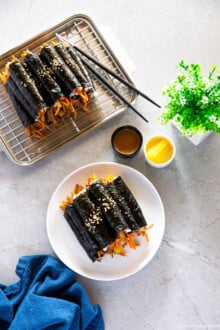
Tuna Rolls (Chamchi Kimbap in Korean)

Tuna Rolls (Chamchi Kimbap in Korean)3

Chamchi Kimbap is my favourite type of Kimbap. It has a savory taste and the smell from perilla leaves (Korean style sesame leaves, ggaennip) and tuna is just well balanced. I haven’t made it myself until today though, I did a pretty good job I think. I have learnt well from Kimgane. :D

Ingredients for 7 rolls (it serves 4 people)

Tuna Rolls (Chamchi Kimbap in Korean) ingredients1

Main ingredients

  • Laver 7 sheets
  • 4½ cups of steamed short grain rice
  • Tuna 250g
  • 7 yellow pickled radish strips
  • 7 long sticks of seasoned edible burdock root
  • 7 sticks of BBQ Kimbap ham (Kimbap ham is made for Kimbap. It is easy to slice.)
  • 4 crab sticks
  • 4 eggs
  • 4 stalks of spinach
  • 1/2 a medium carrot
  • 14 perilla leaves
  • Some mayonnaise

Seasoning (mix these in a bowl)

  • Sesame oil – 1tbsp
  • Salt – 1/2 tsp
  • Sugar – 1 tsp (I used dark brown sugar, the only sugar I have in my kitchen)
  • Vinegar – 1tbsp

Prep

  • Cut the roots off from the spinach, rinse it and parboil it in boiled water. (For 1 minute)
  • Drain the water, and put the spinach into a bowl. Add 2 sprinkles of salt and 1 dash of sesame oil on the spinach then mix it well.
Tuna Rolls (Chamchi Kimbap in Korean) prep1
  • Beat one egg in a bowl. Fry the egg in a pan and make the egg stick by rolling it. (it rolls well when it is 60-70% cooked) Repeat this with the rest of the eggs.
Tuna Rolls (Chamchi Kimbap in Korean) rolling the eggs
  • Cut the crab sticks and egg rolls in half. (Length ways, they will give you a total of 8 sticks each, but we will need only 7 each from them. So you can have spare ones if you are hungry.)
  • Cut the carrot into long thin slices. Make 14 sticks of it. We will use 2 carrot sticks per Kimbap.
  • Take out the rice from the rice cooker or pot. Add 1/2 of the seasoning on the rice. Mix it well. (The rice needs to be cooled down a little bit.)
  • Cook the carrots, crab sticks and BBQ ham in a pan with a little oil. (You can use un-cooked fillings, but I prefer cooked ones. When I cook these I prefer the order in the following picture, that way I can use one pan without washing it.)
Tuna Rolls (Chamchi Kimbap in Korean) prep2
  • Rinse the perilla leaves.
  • Put all the ingredients on one or two plates (depends on the size of the plate). It makes organized rolling.

Making

Tuna Rolls (Chamchi Kimbap in Korean) Making process
  1. Place one laver on the bamboo mat.
  2. Put the rice on the laver. You need to spread it thinly and fast, otherwise the laver get soggy. Leave the top 10% of the laver empty. (To spread the rice, I use my fingers and rice spatula. Have a bowl of cold water next to you to rinse your finger tips when the rice sticks on your fingers too much.)
  3. Put the two perilla leaves in the centre of the rice. (Facing each other)
  4. Put two carrot sticks, 2-3 spinach leaves, some tuna, mayonnaise on top.
  5. On top of that put the crab stick, ham, burdock stick, yellow radish, and egg stick (all one each).
  6. Lift the bottom end of the laver to cover the ingredients, once you cover it then roll it. (Paste some water at the edge of the laver, if it doesn’t stick).
  7. Once you have made rolls, paste the other half of the seasoning onto the laver surface and slice them.
  8. Serve it on the plate.
Tuna Rolls (Chamchi Kimbap in Korean)1

My chamchi Kimbap was very delicious, like some luxurious Kimbap restaurant. It was also cheaper to make 7 rolls of chamchi Kimbap myself than buying them from a Kimbap shop, because 1 chamchi kimbap is 2500 won at Kimgane, so I made 17,500 won (US $18.40) worth of Kimbap today for less than half the cost for the ingredients. What a bargain!

I hope you enjoy having this chamchi Kimbap.

Tuna Rolls (Chamchi Kimbap in Korean)2

Related Posts

Vegetable kimbab

Traffic Light Kimbap

Kimbap Places in Korea