Category Archives: Food and Culture

Raengmyun in Pyongyang

I got an interesting email from one of my readers, Paul, the other day. It was about his food experience in Pyongyang. So naturally it drew my attention (I’ve never been to North Korea before. Have you?). His description about the Raengmyun (Naengmyun for North Korean) he had was very descriptive and he also kindly attached some photos for us to share.

The restaurant he visited is called “Okryugwan (옥류관) “, one of the landmarks in North Korea, and is located near Daedong river.

Okryugwan0803

(Photo from news.naver.com)

North Korean food is generally known to have a purer and clearer taste than South Korean food. If you are used to the artificial taste of some other food, it might taste quite bland.

Here are some photos of what Paul had and his description about them. Thanks Paul for sharing your experience with us.

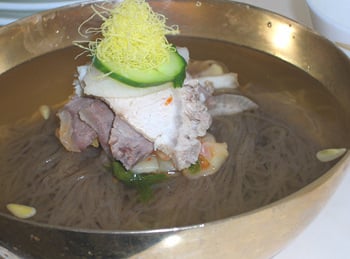
Raengmyun0803

(Raengmyun in a brass bowl – Brassware is one of the Korean traditional dishes and apparently it keeps cold food cold and warm food warm. )

The noodles arrived extremely cold and contained a chewy texture. The buckwheat hulls would separate and offered great texture contrast while chewing. The broth was very mild, not salty nor “meaty” flavored but pure and clean.

Sauce0803

The mustard and hot pepper condiments are house made. The mustard packed a great punch, but just enough so the noodles natural flavor came through. The red pepper sauce is a winner and combined both sweet and aromatics, one of the best in my memory. Finally vinegar, was just that, white vinegar most likely vegetable as the smell was quite mild.

Tangpyongchae0803

(I am guessing this is one of the side dishes. It looks like Tangpyongchae – mung bean jelly with beef and egg topping. Is that right, Paul ?)

The many kimchi varieties in Pyongyang tasted to be quite sweet and mild and did not contain heavy amounts of garlic. I learned that this is a Pyongyang characteristic with Kimchi. Truly an eye-opening experience!

If you would like to share your unique Korean food experience with us, please send me an email (sue at mykoreankitchen.com) with photos.

Difference Between Bibim Naengmyun and Bibim Guksu

If you started to wonder what is different between bibim naengmyun and bibim guksu when you read my bibim guksu post the other day, I wouldn’t be surprised. I wasn’t quite sure which one is more accurate as the title either.

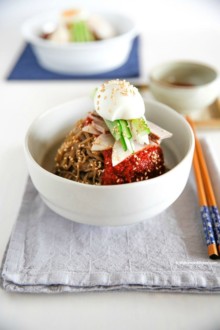
Here is a beautiful picture of bibim naengmyun taken by Evil jungle prince and compare it with my bibim guksu picture. Have a close look. Can you tell what the difference is? Not including the toppings?

bibim naengmyun 0602

(Bibim Naengmyun)

Bibim Guksu05291

(Bibim Guksu)

As far as I know, the main difference is “the noodles”. Naemyun noodles are usually made of buckwheat flour, sweet potato starch or potato starch. They are very resilient and relatively harder to cut with your teeth.

On the other hand, guksu noodles are usually made of wheat flour and sometimes something else added like the soba noodles I used for my bibim guksu (The noodles had 69% wheat flour and 29% buckwheat flour).

I prefer guksu noodles over naengmyun noodles because they are easier to chew, therefore less messy to eat and feels easy on my stomach. What about you?

Here is some information on naengmyun if you are interested.

mulnaengmyun0602

(Mul naengmyun, photo from hankooki.com)

Types of Korean Naengmyun

  • Pyongyang naengmyun – Mul naengmyun, served in cold watery radish kimchi broth, the noodles are usually 70% buckwheat flour and 30% starch powder
  • Hamhung naengmyun – Bibim naengmyun, served in spicy seasoning without the broth, the noodles are usually 100% potato starch.
  • Busan style Milmyun – the noodles are are usually 70% wheat flour and 30% starch powder

milmyun0602

(Type of Milmyun, photo from Gaya milmyun)

Related posts

Instant Cold Noodles in Broth (Mul Naengmyun)

Buckwheat Noodles (Memil Guksu in Korean)

Picture of the Week – Colorful Healthy Sherbet

Colorful Bingsu

(photo from – Naver news )

Yellow sherbet from citron (유자 yuja), purple sherbet from mountain berry (복분자 bokbunja) and green sherbet from green tea.

Do sherbets cool you down? If I tell you the price, you will chill even more!
They are 15,000 won (US $16.00) each before VAT. Have a nice summer!

Picture of the week – Grilled Spicy Pork

Grilled Spicy Pork

(Photo from http://www.munhwa.com)

I started this “picture of the week” thing from last week.
I go through lots of Korean publications on the internet to find “That Korean Food Picture”, which grabs my attention. It is to engage you with some awesome Korean food that is made by an expert.

Today’s picture is grilled spicy pork and lots of side dishes. The pork looks quite spicy (mainly seasoned with Korean chili powder) yet the meat grilled straight on the fire fire is truly tasty!

Picture of the Week – Korean Casserole (Sinseollo)

Picture of the week - Korean Casserole

(Photo from http://isplus.joins.com)

I haven’t had Sinseollo (Korean Casserole) yet. Have you?
Doesn’t this picture look gorgeous!?